Ride to Liberty:
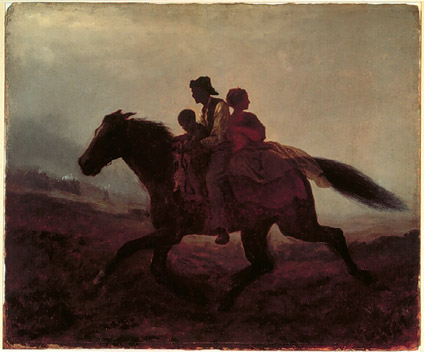
| The young American painter Eastman Johnson based this dramatic image on a scene of fleeing slaves that he witnessed on March 2, 1862, while traveling with Union troops at Centerville, Virginia. Although a number of American painters spent time with Civil War regiments, few recast their observations and sketches as finished paintings. The painting demonstrates Johnson's own sympathy for the abolitionist cause, notably at a moment in the early months of 1862 when Union troops were beset by serious losses, and it remains one of the most moving images created by any American artist during the Civil War. |
Though buried under the shroud of forced shame and oblivion for many generations, with barely a flicker of rumor or flash of oral recitation to keep it alive, the glories of African History (whether among Europeans, or the transplanted Europeans in the New World) will surely resound throughout the future of the human race.The story has not been told, because there was not yet poets to tell it. But those poets are here, now. They are among us. And the story will begin to be told. A story of enurance and faith, of loyalty and struggle, of harrowing courage and, sometimes, narrow escape. And yes, as with every epic, noble tales, full of pathos, tales of great heroes andf martyrs who, unafraid in the face of death, proved to all time they were not slaves, but warriors, heroes, MEN of Valor, Faith, and Pride.
Not afraid to live, not afraid to die,
Not afraid to hurt and love and cry . . .
Determined to survive
Determined to live and thrive
Determined to tell the story
Before earth and sea and sky.Theirs is a story that will be sung to the end of all time. It will shine like the EXODUS. It will surpass the exploits of the Greeks and Trojans. It will equal the stirring epics of the heroic Age of India. And it will inspire all races, echoing to the end of time.

Black and White Kissed
something new lept into being
Joseph R. Washington
Marriage in Black and White
Boston: Beacon Press, 1970. (p34-35)
Quoting:
Maurice R. Davie
Negroes in American Society
New York: McGraw Hill, 1949. (p. 391)
Alexandre Dumas was the son of a Haitian planter and a Negro woman. Alexander Pushkin, founder of modern Russian literature, was the offspring, on his mother's side, of a full-blooded Negro. Alessandro de' Medici, first hereditary Duke of Florence, was the illegitimate son of Giulio, who later became Pope Clement VII, and a mulatto servant girl; he married Margaret, the illegitimate daughter of Charles V. John VI, King of Portugal, was a dark mulatto; his son, Pedro I, became the first emperor of Brazil. The Empress Josephine is alleged to have been a near white. Rogers claims that Robert Browning, Beethoven, and Haydn, among others, had Negro ancestry, and calls attention too the fact that thousands of Guinea Negroes were imported into Europe in the early centuries of the African slave trade (1440 to 1773) and that today not one of these pure blacks remains. The absorption was probably greatest in Spain and Portugal.
Among notable Americans, the story persists that Alexander Hamilton, who was born in the Island of Nevis, British West Indies, was of Negro descent. Complete proof or disproof of this allegation is difficult, since he was born out of wedlock. If Hamilton was not Negro, he certainly brought two Negro sons into the world. One married a very light-colored wife; the other married into a white family and lived as white.
And then there's Lincoln ....
[Note: Republicans of Lincoln's own day hotly denied that Lincoln was of mixed blood, or part African, but Democrats repeated this accusation constantly, and it was perhaps the most consistent, if under-handed, ploy used (had it worked) to defeat Lincoln. Oh how they hated that "Negro" from Illinois, that "Black Republican." Moreover, southern Democrats sometimes even had specific details to go with the charges, such as his North Carolina origins, or his 'real' father's identity, Inlow or Enloe. Lincoln himself never to my knowledge answered the charge directly, and only addressed the issue, as it were, from a distance. Lincoln said, for example, "I'm less concerned about who my grandfather WAS, than who my grandfather's grandson IS." ]
What is the verdict of history on Lincoln? Vachel Lindsay called him 'That bronzed, lank man' -- but I don't think science, least of all genetics (with our modern DNA arsenal) has even attempted to weigh in. Genealogists detail Lincoln's Quaker ancestry, which he himself candidly acknowledged (even adopting the socalled 'Quaker Beard' after his 1860 election), but he called his heritage OBSCURE.
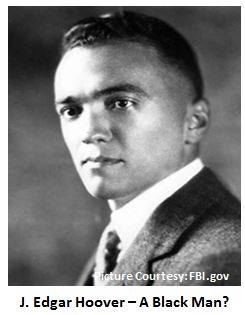
J. EDGAR HOOVER: THE QUESTION THAT WON'T DIEHoover's grandfather lived in a segregated black area and was classified in a census as "coloured"By American cultural standards and practices, one drop of Black blood makes an individual 100% Black. If so, since that is the conventional American standard for racial classification, was J. Edgar Hoover, the infamous founding director of the FBI, passing for White? California educator Millie McGhee, author of "Secrets Uncovered" and an African American, talks about her research into her family genealogy and her revelation that Hoover was her grandfather's second cousin. If these allegations are true, J. Edgar Hoover was, according to American common law, an African American. [Tony Brown's Journal]
Two Souls - the African, the American
The Bitter Debate Over Gay Marriage
| White Man's Fall From Grace |
|
The Death of the West
Yet critics called them 'interlopers' or yankee outsiders, or communist-inspired. Some black matrons called them sluts.
A nation or civilization that continues to produce soft-minded
men purchases its own spiritual death on an installment plan.
Martin Luther King, Strength to Love
The West - Pampered, Educated -- and "Soft"
A pentecostal woman says
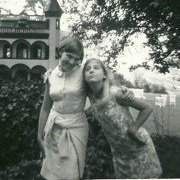 They were do-gooders and well-meaning. But many were naive and did not know what they were getting into.
 White Women in the Freedom Movement.
Most were young and eager and altruistic. They came from pampered backgrounds, and some were deeply religious.
Others were passionately committed to idealism, justice and reaching out to the underprivileged Negroes of the South.
Page
by
Robert Shepherd

friend me (facebook)